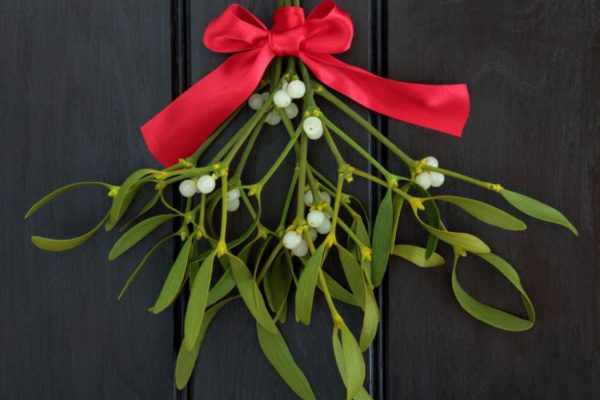
During this holiday season I’ll bet you found yourself under a sprig of mistletoe a time or two. You might even received a few pecks on the cheek.
But mistletoe isn’t just for kissing. It also shows great hope as a powerful weapon in the fight against cancer.
You don’t hear much about it here in the U.S. But over in Europe, doctors have used mistletoe to treat cancer since the 1920s. European hospitals even consider it a routine treatment protocol. And cancer patients swear by it.
That’s because certain phytonutrients in mistletoe kill off cancer cells by blocking the formation of new blood vessels.
You see, cancer cells require the growth of new blood vessels to spread. It’s a process called “angiogenesis.” Blocking it kills cancer cells before they have a chance to cause a problem.
And for anyone undergoing chemotherapy or radiation, mistletoe can reduce side effects, boost your quality of life and may help put tumors into remission.
While we are well behind Europe when it comes to the use of mistletoe for cancer, John Hopkins Researchers released what may be the first U.S. phase I trial on its effectiveness in February, 2023.
The researchers recruited 21 patients with advanced and treatment-resistant cancers of various types and who failed to show improvement after previous therapies.
The patients received intravenous mistletoe three times a week. At the end of 15.3 weeks of follow-up, the disease stabilized in five patients. And in three patients, tumors decreased in size. So these first U.S. results are promising, and I hope to see more of them in the future.
But that’s not all. We’ve also seen that adding mistletoe to cancer therapy can improve survival rates and quality of life for patients with advanced or metastatic non-small-cell lung cancer, breast cancer, and pancreatic cancer.
In the meantime, it’s not a good idea (or good manners) to pluck that mistletoe from above your head and eat it. The plant itself can be toxic. You want a mistletoe extract, where researchers have isolated the key compounds – less the toxins.
Unfortunately, mistletoe isn’t available here in the same intravenous IV form they use in Europe, unless it is part of a clinical trial like the one above. But if you want to take advantage of its healing properties, you can always get the extract in the form of powder or capsule.
This is just one holiday secret I have to share with you today.
🎁Cinnamon for Brain and Blood Sugar
Next on the list is the winter spice that goes into some of my favorite holiday foods. It’s what gives spiced yams and cinnamon baked apples their “zing.”
I’m talking about cinnamon. It has so many great health advantages that you should be eating it every day – not just during the holidays. It’s my go-to secret for lower blood sugar.
Just 6 grams of this oriental spice can cut your blood sugar levels by almost third. It also slashes triglycerides and LDL by about the same.
This is great news if you’re diabetic, pre-diabetic or suffering from metabolic syndrome. It means cinnamon can help protect you from diabetes-related cardiovascular risks. And since people with diabetes have a higher-than-average risk of having a heart attack, this gives cinnamon an important role in your life.
But the good news doesn’t stop there. The compounds in cinnamon may also help ward off Alzheimer’s disease. It could even alleviate existing Alzheimer’s symptoms.
That’s because cinnamon appears to block tau filaments, which researchers associate with Alzheimer’s. In fact, studies have even shown that it disassembles the filaments, thus reversing the cell damage.
So don’t save cinnamon for the holidays. Make a habit of using it liberally throughout the year. It’s easy to add a spoonful to a cup of hot tea… apple cider… and even sprinkled on some of your favorite foods.
But before you grab a container of cinnamon and start sprinkling over the foods you eat, make sure it’s the right kind.
Cassia cinnamon contains something called coumarin. Coumarin can have adverse side effects and, as a food additive, the United States bans it. But if it’s in a natural food, it’s not regulated. So make sure you look for Ceylon cinnamon, which people commonly know as the “true” cinnamon. It contains much lower levels of coumarin.
🍒 Cranberries For UTIs and More!
I’m not talking about that red cranberry gelatin that people pass around with turkey and dressing at holiday feasts. But cranberries themselves offer up a host of health benefits. And they go well beyond simply treating urinary tract infections.
In particular, cranberry juice can have a profound effect on your cardiovascular health. It helps balance out your LDL to HDL ratio. And if you have high blood pressure, it works as an ACE inhibitor to widen blood vessels and improve blood flow.
It even helps reduce inflammation and arterial stiffness.
I suggest skipping that sticky red gelatin and those sugary cranberry juice “cocktails.” Instead, just add an ounce of 100% cranberry juice to water or your usual juice. Or take 400 mg of supplemental cranberry extract daily for the same benefits.
SOURCES:
Mistletoe Extracts (PDQ®). National Cancer Institute. Updated: June 8, 2023.
Elluru SR, Duong Van Huyen JP, Delignat S, Prost F, Heudes D, Kazatchkine MD, Friboulet A, Kaveri SV. Antiangiogenic properties of viscum album extracts are associated with endothelial cytotoxicity. Anticancer Res. 2009 Aug;29(8):2945-50.
Kienle GS, Kiene H. Complementary cancer therapy: a systematic review of prospective clinical trials on anthroposophic mistletoe extracts. Eur J Med Res. 2007 Mar 26;12(3):103-19.
Paller CJ, Wang L, Fu W, Kumar R, Durham JN, Azad NS, Laheru DA, Browner I, Kachhap SK, Boyapati K, Odeny T, Armstrong DK, Meyer CF, Gaillard S, Brahmer JR, Page I, Wang H, Diaz LA Jr. Phase I Trial of Intravenous Mistletoe Extract in Advanced Cancer. Cancer Res Commun. 2023 Feb 28;3(2):338-346.
Schad F, Thronicke A, Hofheinz RD, Matthes H, Grah C. Patients with Advanced or Metastasised Non-Small-Cell Lung Cancer with Viscum album L. Therapy in Addition to PD-1/PD-L1 Blockade: A Real-World Data Study. Cancers (Basel). 2024 Apr 22;16(8):1609.
Thronicke A, Schad F, Debus M, Grabowski J, Soldner G. Viscum album L. Therapy in Oncology: An Update on Current Evidence. Complement Med Res. 2022;29(4):362-368.
Hong CE, Lyu SY. Mistletoe in Cancer Cell Biology: Recent Advances. Curr Issues Mol Biol. 2025 Aug 20;47(8):672.
Khan A, Safdar M, Ali Khan MM, Khattak KN, Anderson RA. Cinnamon improves glucose and lipids of people with type 2 diabetes. Diabetes Care. 2003 Dec;26(12):3215-8.
Peterson DW, George RC, Scaramozzino F, LaPointe NE, Anderson RA, Graves DJ, Lew J. Cinnamon extract inhibits tau aggregation associated with Alzheimer’s Disease in vitro. Journal of Alzheimer’s Disease. 2009;17(3):585-597.
Momtaz S, Hassani S, Khan F, Ziaee M, Abdollahi M. Cinnamon, a promising prospect towards Alzheimer’s disease. Pharmacol Res. 2018 Apr;130:241-258.
Blumberg JB, Camesano TA, Cassidy A, Kris-Etherton P, Howell A, Manach C, Ostertag LM, Sies H, Skulas-Ray A, Vita JA. Cranberries and their bioactive constituents in human health. Adv Nutr. 2013 Nov 6;4(6):618-32.